Medd AI Web App
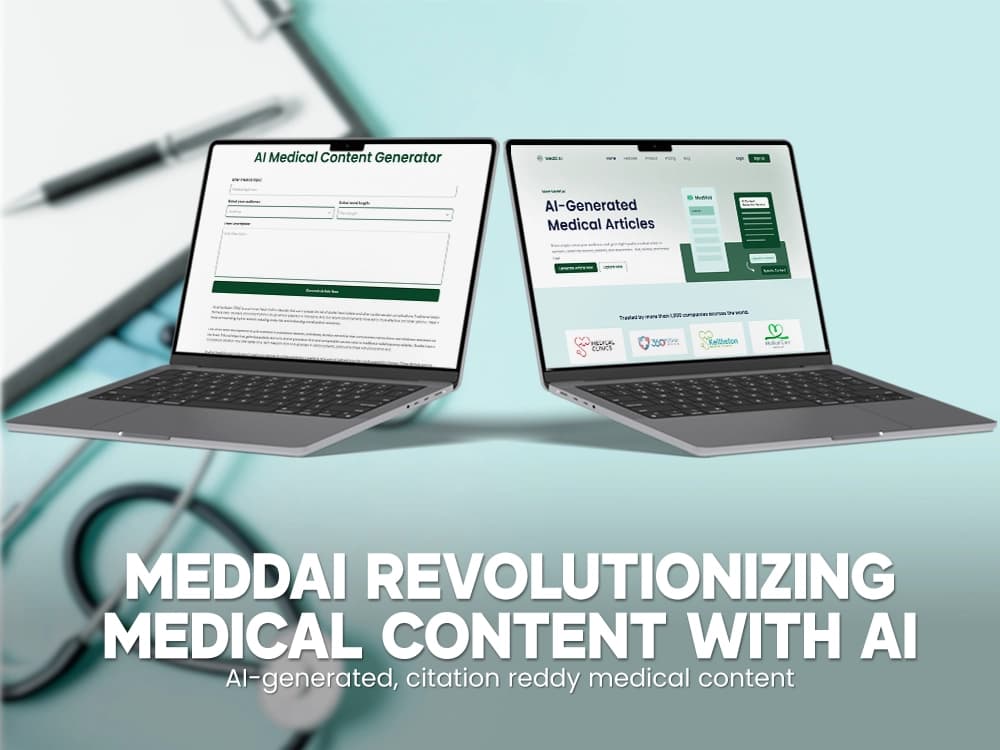
A web app that drafts compliant medical content tuned to brand voice, with built-in approval and publishing workflows.
MeddAI — Medical Content Creator AI Web Application
MeddAI is an AI-powered web application built to generate trustworthy, citation-ready medical content for healthcare professionals, students, and the public. It uses a FastAPI backend with Python, orchestrates multiple AI agents using LangGraph, and integrates Google Gemini and OpenAI GPT-4o for content generation and validation. Perplexity AI is used for research when no external references are provided.
The platform accepts inputs like URLs, DOCX/PDF files, and YouTube videos. It performs real-time source extraction, automated medical accuracy checks, and delivers AMA-style formatted articles. A REST API interface allows seamless content requests by both technical and non-technical users.
Solving real problems with smart engineering
Validating Medical Accuracy
Risk of generating inaccurate or non-compliant content that could mislead healthcare audiences.
Implemented GPT-4o for post-generation validation — checking factual accuracy, AMA citation format, and readability. Invalid drafts are automatically flagged and returned with issue logs.
Ingesting Multiple Content Types
Required support for diverse sources like PDFs, DOCX, web pages, and YouTube videos in a single pipeline.
Integrated Firecrawl for web pages, PyPDF2 / python-docx for documents, and RapidAPI for YouTube transcription — seamless ingestion and parsing across formats.
Dynamic Audience Adaptation
One-size-fits-all tone fails across user groups — doctors, students, patients, and the public all need different language.
Language generation dynamically adjusts tone and jargon to fit doctors, students, patients, or the general public based on the request context.
Citation-Enforced Content
Generated content lacked scholarly reference formatting — making it unusable for evidence-based publication.
Google Gemini is instructed with strict prompting to embed in-text citations and meet academic AMA formatting standards.
Have a similar project in mind?
Let's talk about how AI can transform your service business.
Discuss Your Idea TodayBuilt with a modern AI stack
- Any client (React.js, Postman, etc.) — sends requests and renders article output
- REST endpoints designed for easy integration into existing UIs
- FastAPI — endpoints for article generation, extraction, and health checks
- LangGraph — orchestrates the multi-step workflow (input → research → generation → validation)
- Python — core business logic and integrations
- Google Gemini — generates draft content with strict citation prompting
- OpenAI GPT-4o — validates factual accuracy and formatting compliance
- Perplexity AI — literature search fallback when no source is provided
- Firecrawl, PyPDF2 / python-docx, RapidAPI — multi-format ingestion
- Auto-routes requests to the right workflow based on input type (URL, PDF, DOCX, video)
- Word-count accuracy within ±10% via Gemini constraints
- Asynchronous validation and rate-limiting for abuse protection
- API keys behind secure access layers; HIPAA-conscious practices

Outcomes that move the business
Evidence-Based Articles
Drafts are verified and citation-compliant using AMA formatting.
Source-Aware Ingestion
Pulls from URLs, PDFs, DOCX, and video sources automatically.
Adaptive for Every User
Tone and depth adjust for doctors, students, patients, or general public.
Plug-and-Play Integration
Ready for EMR systems, LMS platforms, and third-party content hubs.